


Guide to Buying a Bamboo Fly Fishing Rod
Before describing the protocol to follow when examining a bamboo fishing rod for purchase, it is useful to clarify the evaluation criteria that should be adopted. Since these rods are mainly acquired either for the pleasure of fishing with them or for collecting, it is ultimately the latter aspect that determines their value and therefore their price.
This does not mean that the pleasure of using a bamboo rod should be underestimated—quite the opposite. It is a very important element in evaluating a rod. However, it is entirely personal and therefore subjective, and cannot be reduced to objective criteria. For this reason, it will not be considered here.
Originality, the quality and refinement of the components, the elegance of their overall combination, rarity, and above all the state of preservation (in the case of a used rod) are the main factors that allow us to determine the quality of the rod we are examining.
At this point, rods considered “antique” – that is, those produced up to and including the 1960s—deserve a separate discussion. For these rods, and especially for those produced from the earliest years up to the 1940s, considerations regarding their state of preservation should be made with a certain degree of flexibility.
Because of their age, these rods often show natural deterioration not caused by use, but simply by the aging of the materials employed. One frequently finds widespread cracking in the varnish (since natural copal varnishes were used), weakening of the glue joints (which were made with animal-based woodworking glue), oxidation of metal components, and similar effects.
Nevertheless, these rods are appreciated for their historical value and for the originality of their finishes, even if those finishes are partially compromised. Some collectors are even willing to overlook obvious defects in order to complete a collection or to obtain a model they have been searching for over many years.
Leaving aside this brief digression on “antique” rods and returning to rods produced in more recent times—which can serve both as fishing tools and collectible items—the following considerations become important.
First of all, it is essential to gather as much information as possible about the characteristics of the model you intend to examine.
It is particularly important to know:
- Model – the full name, any abbreviations, and their meanings
• Length – the exact length of the rod being analyzed (almost always expressed in feet and inches)
• Line weight – generally indicated by a number representing the line the rod is designed to cast, usually preceded by the symbol # (according to the international AFTMA scale)
• Components – knowledge of the original components allows us to immediately recognize any replaced parts, which—even if minor—can significantly reduce the value of a collectible rod
• Accessories – such as the type of rod bag, the presence of a rod tube, spare tip sections, compensation pieces on rods whose tip section is longer than the butt, and so on
Once the rod’s conformity to its original equipment has been verified, the rod itself should be carefully examined, ideally in clear natural daylight. This inspection is mainly intended to reveal any work that may have been carried out on the rod: revarnishing, replacement of wraps or guides, micro-fractures (particularly in agate stripping guides, which are prone to fine cracks or chipping), or small nicks in the bamboo caused by impacts or by fly hooks striking the delicate tip section.
The good preservation of rod bags, tubes, and other accessories is also important, since these elements contribute to the completeness of the rod as a collectible object. Their good condition is essential if the rod is to maintain its highest possible valuation. One detail that is often overlooked is the length of the rod bag: if it has been washed, it may have shrunk and may no longer correspond to the correct length for the rod it should contain.
Protocol for Examining a Bamboo Rod
1 – Identify the maker, model, full name of the rod, length, and original accessories.
2 – Verify that the rod itself corresponds to the characteristics identified in point 1.
3 – Examine the selection and condition of the bamboo.
For a contemporary rod, the analysis should focus on the spacing of the nodes (3×3, 2×2×2, spiral, etc.), the quality of the gluing of the six bamboo strips and the absence of visible glue lines, and the preservation of the outer bamboo fibers during planing—the well-known power fibers.
In the case of a second-hand rod, the inspection should also confirm the good preservation of the bamboo: absence of nicks caused mainly by fly impacts, integrity of the glued strips, and the overall condition of the material.
A feature that is often checked immediately when examining a bamboo rod is whether it is perfectly straight. This is particularly important in a new rod, which should not have experienced any stress. In used rods, however, the strain created when playing larger fish often produces a slight “set” in the bamboo. If not excessive, this should be accepted as part of the rod’s character.
Personally, I am opposed to heat-straightening used rods. In attempting to correct a minor problem, one risks creating far more serious ones—particularly concerning the integrity of the glue joints between the strips and the rod’s varnish.
4 – Examine the original varnish.
Any revarnishing will usually be visible when the rod is observed against the light. If present, it significantly reduces the rod’s value.
5 – Examine the wraps.
In a contemporary rod, attention should be paid to the regular progression of the thread turns, the presence of small imperfections such as poorly trimmed thread ends, and the choice of colors—which are not always aesthetically pleasing (although this remains a personal judgment).
In a used rod, the inspection should focus mainly on signs of rewrapping and cracks in the varnish. A particularly vulnerable area is the wraps around the ferrules. With rigid varnishes—or varnishes that have hardened over time—fine cracks often appear, which may allow moisture to penetrate beneath the varnish and cause damage.
6 – Examine the ferrules.
In addition to their varnish condition, the most important factor is how the ferrules fit together. A male ferrule that slides too easily into the female ferrule will certainly have a shorter lifespan than one that engages with slight resistance.
Any noises heard during casting or use that originate from the ferrules may indicate looseness or imperfect seating.
Defects in ferrules should never be underestimated. Replacing a ferrule is both complex and expensive, and it seriously compromises the originality of a collectible rod. It is almost impossible to find a replacement ferrule identical to the original, and the intervention inevitably affects both the wraps and the varnish. Furthermore, it is extremely difficult to match the original thread type and color; even if the correct materials are available, the threads already on the rod will often appear slightly lighter due to fading caused by exposure to light.
7 – Examine the tip section and the tip-top guide.
Besides verifying the absence of nicks caused by fly impacts, attention should also be paid to the condition of the tip-top, which is often accidentally struck against ceilings when rods are assembled and waved indoors.
8 – Test the rod in action, even on grass (if permitted).
This final step is the definitive test. A rod may pass all the previous inspections and still not be the right rod for you as an angler. The previous analysis will have determined whether it is a well-built and well-preserved rod, therefore valuable from a collector’s perspective.
However, only actual casting—preferably on water (since the shooting effect of the water on the line should not be underestimated)—will determine whether the rod suits your personal casting style and fishing needs. Only then will you know if it is the rod that allows you to perform the necessary fishing actions in the simplest and most enjoyable way possible.
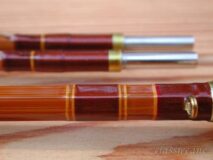
(In the photo above, a detail of a fly fishing rod by Gary Howells.)
Florence, October 29, 2007
Simone Falchini
